
Table of Contents
- Why Screen Free Activities Matter for Preschoolers
- Screen-Free Indoor Activities for Toddlers and Preschoolers
- Outdoor Activities for Preschoolers That Burn Energy
- No-Cost Activities for Preschoolers Using What You Already Own
- Preschool Activities at Home: A Simple Weekly Plan
- Creative Arts, Crafts, and Imaginative Play
- Safety, Setup, and Cleanup Tips for Busy Caregivers
- Frequently Asked Questions
Last Updated: October 21, 2026
Why Screen Free Activities Matter for Preschoolers
Parents often tell us they want to cut screen time but don't know what to replace it with.
The American Academy of Pediatrics guidance on children and media recommends prioritizing creative, unstructured play for young children, and for good reason.
Below, we'll show you how to build a week of screen-free play using what you already own, plus a few printables that make quiet time easier.
Screen-Free Indoor Activities for Toddlers and Preschoolers
Indoor play works best when you set up one clear invitation to play and step back. Over-planning, five activities spread across the floor, creates chaos, not engagement.
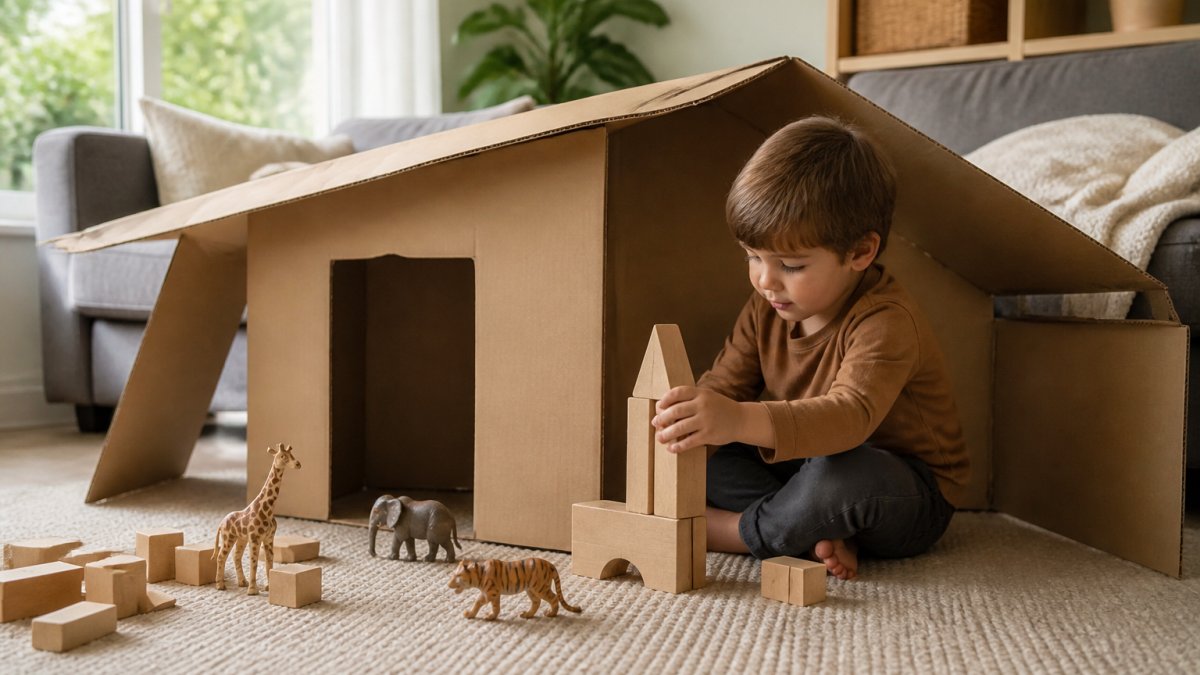
Building and Construction Play
Building play develops problem-solving and spatial reasoning. Stacking, balancing, and knocking things down teaches cause and effect in a way a screen never can.
- Cardboard box creations: Tape two boxes together and hand over crayons. A box becomes a castle, a bus, or a cave.
- Tape road: Run painter's tape across the floor in a loop. Add toy cars and let your child drive the route.
- Block towers: Challenge your preschooler to build the tallest tower that stays standing. Count the blocks together.
Don't step in too early when the tower falls, the fall is the lesson. Ask "what would make it steadier next time?" and let them try again.
Sensory Bins and Quiet Play
Sensory play calms a wound-up child and builds fine motor skills at once. A sensory bin is simply a shallow container filled with a safe filler and a few scoops.
- Rice, beans, or pasta: Fill a tub with dry rice or dried pasta. Add measuring cups, spoons, and small toys to bury and find.
- Posting game: Cut a slot in a shoebox lid. Let your child post flashcards, bottle caps, or cut-up cardboard through the slot.
- Water play: A shallow tray of water with cups and sponges works wonders on a hot afternoon.
For quiet time, our Young Tykes Tracing Flashcards give little hands a focused task: tracing letters, numbers, and shapes on guided lines. Laminate them for reuse with a dry-erase marker.

Outdoor Activities for Preschoolers That Burn Energy
Outdoor play is the fastest route to a tired, happy preschooler. Fresh air plus space to run solves most afternoons.
Scavenger Hunts and Nature Walks
A scavenger hunt turns a walk around the block into an adventure. Keep it simple: name five things to find and let your child carry the list.
- Colour hunt: Find something red, yellow, green, and brown.
- Texture hunt: Something rough, something smooth, something soft.
- Nature walk: Collect three leaves and one interesting stick, then bring them home for leaf printing.
Our Toddler Beginner Flashcard Bundle works surprisingly well here: hide the animal and fruit cards around the yard and have your child match each to what they find.

An obstacle course is the other outdoor winner: cushions to jump over, a rope to balance along, a bucket to throw a ball into.
No-Cost Activities for Preschoolers Using What You Already Own
You do not need to buy anything to run a good screen-free day. Most of the best activities use items already in your kitchen or recycling bin.
- Kitchen band: Pots, pans, and wooden spoons. Loud, but effective.
- Laundry basket toss: Roll socks into balls and throw them into a basket.
- Paper snowflakes or leaf printing: Fold paper, cut shapes, or press painted leaves onto card.
The one thing worth spending on is a small set of reusable printables. Our Professor Scribbles Construction Adventure Colouring Book is a digital download with 15 bold-line pages of diggers, dump trucks, and mixers, costing less than a coffee, print at home and reprint any page your child destroys.
Preschool Activities at Home: A Simple Weekly Plan
A weekly plan removes the daily "what do we do now?" scramble. Alternate high-energy and quiet activities so your child gets both movement and calm each day.
| Day | Activity | Type | Setup Time | Materials |
|---|---|---|---|---|
| Monday | Cardboard box fort | Building | 5 min | Boxes, tape, crayons |
| Tuesday | Nature walk and leaf hunt | Outdoor | 2 min | Bag, printed list |
| Wednesday | Sensory bin with pasta | Sensory | 5 min | Tub, pasta, scoops |
| Thursday | Obstacle course in the yard | Active | 10 min | Cushions, rope, bucket |
| Friday | Tracing flashcards and coloring | Quiet | 2 min | Printables, crayons |
| Saturday | Dance party and freeze game | Movement | 1 min | Music player |
| Sunday | Scavenger hunt at the park | Outdoor | 3 min | Printed cards |
Print this plan and stick it on the fridge. Adjust freely: if Tuesday rains, swap in Wednesday's sensory bin. The structure matters more than the specific activity.
Creative Arts, Crafts, and Imaginative Play
Creative play is where preschoolers work out what they've seen and heard. Drawing, pretending, and building stories build language and confidence, and give a child a safe way to rehearse real-life situations. Match the invitation to your child's stage, a three-year-old and a five-year-old need very different setups for the same activity.
Age adaptations for the same activity
Most activity lists give one version and leave you guessing whether it fits your child. Here's how to scale three common creative activities up or down by developmental stage.
- Pretend play shop. Younger preschoolers (around three) do best with a simple exchange: hand you a box, take a coin, say thank you. Older preschoolers (four to five) can handle a written price list, a till, and a customer queue. Add a clipboard and a pencil for the older group and the play extends into early writing.
- Rock painting. For a child still developing grip, use chunky brushes and a single colour per rock. For a child with more control, offer thin brushes, a palette, and a design plan drawn on paper first. Washable acrylic is easier to clean from hands; outdoor acrylic holds up better on a porch.
- Leaf printing. Younger children can press a painted leaf onto paper with hand-over-hand help. Older children can arrange several leaves into a pattern, label the tree they came from, and hang the print to dry.
A common pattern is that caregivers under-estimate what a four-year-old can plan and over-estimate what a three-year-old can share. Adjust the number of steps, not the activity itself.
Toddler Beginner Flashcard Bundle →
Pretend play that builds language
Set up a "shop" with empty food boxes and a toy till, or a "doctor's office" with a teddy bear patient. The learning happens in the talk around the play: "What does the customer want?", "How much is the apple?", "What should the doctor check first?" Ask one open question and then wait.
A doctor's kit, a cardboard keyboard, or blank "appointment cards" is enough, no full play kitchen needed. The richer the language you model, the longer the play runs.
Art with low mess and low setup
- Coloring books. Our Bold and Easy First Words A-Z pairs chunky letters with friendly characters across 30 pages, which suits a preschooler still learning letter shapes. Setup is under a minute: print, hand over crayons, done.
- Leaf printing. Paint the back of a leaf, press it onto paper, and peel. Put a sheet of newspaper down first and the cleanup is a single fold-and-toss.
- Rock painting. Smooth stones plus acrylic paint. Let them dry on the porch. A shallow cardboard tray keeps drips contained.
The National Association for the Education of Young Children on play and learning notes that open-ended creative play supports both self-regulation and early literacy. That's the case for keeping art supplies within reach rather than packed away.

Inclusive adaptations
Not every preschooler will take to a craft the same way. If your child has mobility, sensory, or communication needs, a few adjustments keep the activity accessible:
- Offer a choice of tools: a chunky grip, a paint dabber, or a sponge brush instead of a thin brush.
- Reduce the steps: one instruction at a time, with a visual card for each step.
- Allow a sensory exit: some children need to wash hands mid-activity, so keep a damp cloth nearby.
Safety, Setup, and Cleanup Tips for Busy Caregivers
Safety and cleanup are where most screen-free plans quietly collapse. Before saying yes to an activity, decide three things: is it safe, how long will setup take, and how much cleanup will it create.
Supervision by activity type
Supervision needs scale with the activity, not with the child's age alone. Use this as a quick rule of thumb:
- Arm's reach: water play, sensory bins with small fillers, and anything involving small magnets. An adult stays within arm's reach the whole time.
- Eyes on: scissors, glue, and active indoor play like cushion obstacle courses. An adult is in the room and checking in every minute or two.
- Check-in: coloring, block building, and pretend play with large props. An adult can be nearby doing another task and look over regularly.
Never leave a child alone with a sensory bin, water tray, or small magnets. If you need to step away, pack the activity up first and finish it later. Water play should always be emptied immediately after use, even a shallow tray.
Choking hazards, by the numbers that matter
A useful test is the toilet paper tube: anything that fits through it is a choking risk for children under three, and for any older preschooler who still mouths objects.
Scissors deserve their own note. Blunt-tip child scissors are the right default for preschoolers, and a seated child at a table is easier to supervise than a child walking with scissors.
Setup time and mess level at a glance
Label activities before you start so you can pick one that fits the moment. A simple three-tier system works:
- Low setup, low mess (under 2 minutes): coloring pages, tracing flashcards, block towers, sock sorting. Good for the gap before dinner.
- Medium setup, medium mess (about 5 minutes): sensory bin with pasta, tape road, leaf printing on newspaper. Good for a planned afternoon.
- High setup, high mess (10 minutes or more): rock painting, water play with multiple containers, obstacle course in the yard. Save these for days with cleanup time built in.
A splash mat or an old sheet under the sensory bin saves ten minutes of sweeping. A shallow cardboard tray under rock painting catches drips. A plastic folder with a few crayons becomes a travel kit that works at restaurants, on flights, and during quiet time, with no screen required.
A five-minute reset routine
Cleanup goes faster when it's part of the play rather than a punishment after it. Sing a cleanup song and tidy together, children copy what they see, and a five-minute reset prevents the pile-up that makes caregivers avoid messy play altogether.
Rotate toys while you tidy. Store half the blocks and puzzles out of sight and swap them monthly. Old toys feel new again, and there is less to clean up at any one time.
Inclusive and accessible adaptations
Accessibility matters too. If your child has learning delays or needs extra support, choose larger materials, fewer steps, and one instruction at a time. Our printables use clean, uncluttered layouts so children aren't overwhelmed by visual noise, and they can be printed larger or laminated for extra grip. For limited mobility, bring the activity to a tray table or the floor.
Frequently Asked Questions
What are some fun things to do without screens?
Try building forts from cardboard boxes and blankets, setting up a sensory bin with rice or dried pasta, or running a scavenger hunt around the house. Outdoor options like an obstacle course, chalk roads, or a nature walk work well too. Keep a few screen free activities ready in advance so you can offer a choice when boredom hits. Rotating ideas every few days stops them feeling stale.
How can I keep my preschooler busy without a screen?
Stock a small shelf of open-ended materials: blocks, playdough, crayons, and a basket of household items like measuring cups and spoons. Set up one activity at a time and let your child lead. Quiet activities such as coloring books or flashcards keep little hands busy during transitions. The Toddler Beginner Flashcard Bundle includes five decks that double as matching games and sorting activities, giving you several screen free activities from one download.
What indoor activities can preschoolers do without screens?
Indoor favorites include building and construction play with blocks or boxes, sensory bins filled with rice, beans, or pasta, tape roads for toy cars, and pretend play with dress-up clothes. Creative arts and crafts like rock painting or leaf printing also work well. For a calm option, try tracing flashcards or a coloring book. Most of these need only a few minutes of setup and household materials you likely already have.
How much screen-free play does a preschooler need?
Preschoolers benefit from most of their waking hours being active, creative, or imaginative play rather than passive screen time. Aim for a daily rhythm that includes movement, outdoor time, and quiet play. You do not need to schedule every minute. A mix of child-led play and short parent-led activities gives structure without pressure, and keeps screen free activities feeling like fun rather than a rule.
The hardest part of screen-free play isn't finding activities. It's having them ready before the boredom hits. Curious Tykes Boutique makes that easier with instant digital downloads you can print in minutes, print-on-demand coloring books with bold, kid-friendly lines, and a free monthly coloring club that keeps fresh pages coming. Join Professor Scribbles Coloring Club and get your first set of screen-free printables today.